Quizzes
Quiz 1
-
Represent the decimal number 75 as a 7-bit binary number:
( 1 ), and as a BCD code:( 2 ). Then add an even parity bit at the most significant bit (MSB) of the BCD code to form a 9-bit code:( 3 ). -
Simplify the Boolean expression \(XY + \bar{X}Z + X\bar{Y} + \bar{Y}Z\) to its minimum number of literals:
- A: \(Y + Z\)
- B: \(X + Z\)
- C: \(X + Y\)
- D: \(X + Y + Z\)
-
Which of the following expressions has its dual equal to its complement?
- A: \(\bar{A} + BC\)
- B: \(\bar{A}B + BC\)
- C: \(\bar{A}\bar{B} + BC\)
- D: \(\bar{A}B + A\bar{B}\)
-
What is the sum-of-minterms (SOM) form of the expression \(F(A,B,C) = \bar{A}B + BC\)?
- A: \(\sum m(2,3,7)\)
- B: \(\sum m(0,1,4)\)
- C: \(\sum m(2,4,6)\)
- D: \(\sum m(2,3,6)\)
Answer
-
As below:
- Binary Code: \(1001011_2\)
- \(75 = 64 + 11\)
- BCD Code: \(0111\ 0101\)
- 9-bit Code (Even Parity): \(1\ 0111\ 0101\)
- Binary Code: \(1001011_2\)
-
B (\(X + Z\))
- D (\(\bar{A}B + A\bar{B}\))
- \(f^D(x, y, z) = \bar{f}(x, y, z) = f^D(\bar{x}, \bar{y}, \bar{z}) \Longleftrightarrow f(x, y, z) = f(\bar{x}, \bar{y}, \bar{z})\)
- A (\(\sum m(2,3,7)\))
Quiz 2
-
For the function \(F = AB(C+D)+C(BD'+\bar{A}D)\), the literal cost is:
( 1 ), and the gate input cost with NOT (GN) is:( 2 ). -
Find the essential prime implicants for \(F(W,X,Y,Z)= \sum m(0,1,4,6,7,8,9,12,14,15)\):
- A: \(Y'Z', XZ'\)
- B: \(\bar{X}\bar{Y}, XY\)
- C: \(XY, XZ'\)
- D: \(Y'Z', \bar{X}\bar{Y}\)
-
Find a minimal sum-of-products (SOP) expression for the function \(F\) with the don’t-care conditions: \(F(A,B,C,D)=\sum m(1,5,6,13,14)+ \sum d(4,12)\):
- A: \(B\bar{C}+\bar{A}\bar{C}D+BCD'\)
- B: \(B\bar{D}+B\bar{C}+\bar{A}\bar{C}\)
- C: \(\bar{C}D+B\bar{C}+B\bar{D}\)
- D: \(B\bar{C}+B\bar{D}+\bar{A}\bar{C}D\)
-
How many implicants, prime implicants (PI), and essential prime implicants (EPI) are there in \(F(A,B,C)=\sum m(0,4,5)+ \sum d(1)\)?
- A: 8, 1, 1
- B: 7, 1, 1
- C: 6, 1, 1
- D: 5, 3, 1
Answer
-
As below:
- Literal cost: 9
- Gate input cost with NOT (GN): 17
-
B (\(\bar{X}\bar{Y}, XY\))
- D (\(B\bar{C}+B\bar{D}+\bar{A}\bar{C}D\))
- A (8, 1, 1)
- Implicants: 3 + 4 + 1 = 8.
- PI/EPI: Combined term \(\bar{C}\) covers all required minterms.
Quiz 3
-
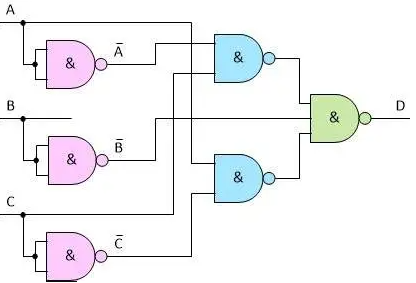
Find the \(t_\text{PHL}\) from input C to the output D, assuming \(t_\text{PHL}=0.20\text{ ns}\) and \(t_\text{PLH}=0.36\text{ ns}\) for each gate.
- A: 0.56 ns
- B: 0.6 ns
- C: 0.76 ns
- D: 0.92 ns
-
Consider a 4-input priority encoder with inputs \(D_3\), \(D_2\), \(D_1\), \(D_0\). The encoder responds to the most significant 1 (highest priority to \(D_3\)). It produces outputs \(A_1\), \(A_0\) and a valid flag \(V\), where \(V=1\) indicates at least one input is 1. What is the logic expression for \(V\)?
- A: \(D_3D_2 + D_1D_0\)
- B: \(D_3D_2 + D_1 + D_0\)
- C: \(D_3D_2D_1 + D_0\)
- D: \(D_3 + D_2 + D_1 + D_0\)
-
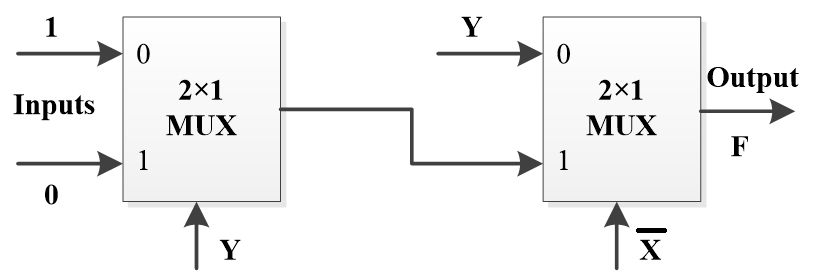
Please find the logic expression of output \(F\) in the figure.
- A: $XY + X\bar{Y}$
- B: $\bar{X}\bar{Y} + XY$
- C: $\bar{X}Y + XY$
- D: $\bar{X}Y + X\bar{Y}$
-
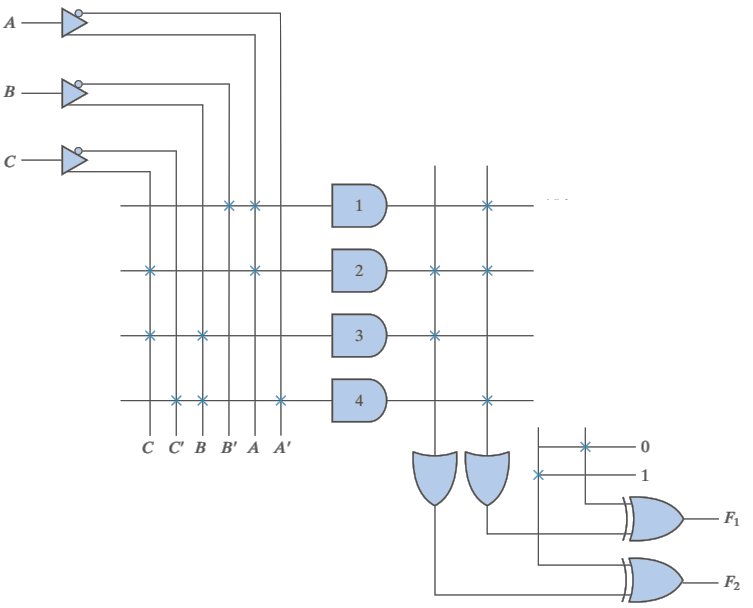
What specific Boolean function does the PLA implement for \(F_2\)?
- A: $AC + BC$
- B: $\bar{C}+\bar{A}\bar{B}$
- C: $\bar{A}C + BC$
- D: $AC + B$
Answer
- C (0.76 ns)
- D (\(D_3 + D_2 + D_1 + D_0\))
- B (\(\bar{X}\bar{Y} + XY\))
- B (\(\bar{C}+\bar{A}\bar{B}\))
Quiz 4
-
For the decimal number \((-32)_{10}\) represented as an 8-bit signed binary number:
- The signed-magnitude representation is
( 1 ); - The signed-1's complement representation is
( 2 ); - The signed-2's complement representation is
( 3 ).
- The signed-magnitude representation is
-
Given two 4-bit signed 2's complement numbers, \(A=(0100)_2\) and \(B=(1101)_2\):
- The result of \(A-B\) is
( 1 ); - Does overflow occur?
- The result of \(A-B\) is
-
Which of the following statements about latch and flip-flop behavior is CORRECT?
- A: Metastable state in a latch occurs when both inputs (S and R) are held at logic 0, causing the outputs to oscillate indefinitely.
- B: Oscillation in a basic SR latch happens when both inputs are 0 and then return to 1 simultaneously, leading to an undefined or endless switching state if gate delays are equal.
- C: 1s catching is a problem in edge-triggered D flip-flops, where a brief glitch on the D input during the clock edge can cause an incorrect output.
- D: A metastable state is a stable, long-term condition that can be intentionally used to store an intermediate logic value.
-
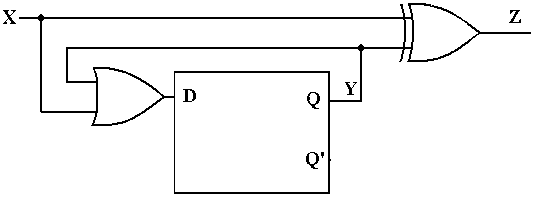
As the sequential circuit shown below, determine its input equation, output equation, and next state equation.
- A: $D=X\oplus Y, Z=X+Y, Q(t+1)=D$
- B: $D=X+Y, Z=X\oplus Y, Q=D(t+1)$
- C: $D=X+Y, Z=X\oplus Y, Q(t+1)=D$
- D: $D=X\oplus Y, Z=X+Y, Q=D(t+1)$
-
The timing parameters for the gates and flip-flops are as follows: NOT Gate: \(t_{pd}=0.75\text{ ns}\); XOR Gate: \(t_{pd}=3.0\text{ ns}\); AND Gate: \(t_{pd}=1.5\text{ ns}\); Flip-flop: \(t_{pd}=3.0\text{ ns}\), \(t_s=1.25\text{ ns}\), \(t_h=0.5\text{ ns}\). Find the longest path delay from positive clock edge to an external output, and the maximum frequency of operation of the circuit.
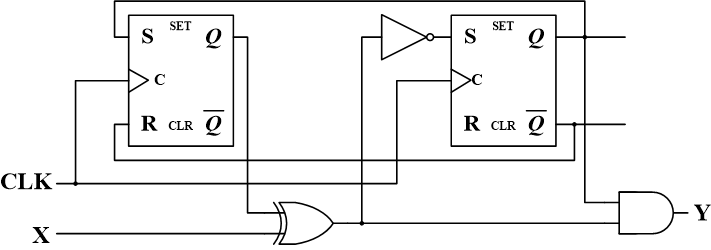
- A: 7.75 ns, 130 MHz
- B: 7.5 ns, 120 MHz
- C: 4.75 ns, 180 MHz
- D: 7.5 ns, 125 MHz
Answer
-
10100000, 11011111, 11100000
- \(32=(00100000)_2\).
- Signed-magnitude: sign bit 1 plus magnitude 0100000 gives 10100000.
- 1's complement: invert 00100000 gives 11011111.
- 2's complement: add 1 to 11011111 gives 11100000.
-
0111, overflow does not occur
- \(A=4\), \(B=-3\), so \(A-B=4-(-3)=7=(0111)_2\).
-
B
- C (\(D=X+Y, Z=X\oplus Y, Q(t+1)=D\))
- D (7.5 ns, 125 MHz)
- Clock-to-output longest path: \(3.0+3.0+1.5=7.5\text{ ns}\).
- Register-to-register critical period: \(3.0+3.0+0.75+1.25=8.0\text{ ns}\), so \(f_{\max}=125\text{ MHz}\).
Quiz 5
-
What is the function of the following 4-bit counter with parallel load?
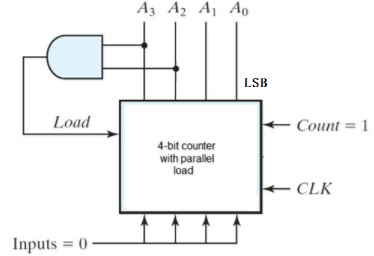
- A: It counts from 0 to 12 and back to 0.
- B: It counts from 0 to 9 and back to 0.
- C: It counts from 0 to 10 and back to 0.
-
Given two 8-bit registers \(R1\) and \(R2\), with \(R1=(1011\ 0110)_2\) and \(R2=(0111\ 1010)_2\). After two microoperations:
- \(R1 \leftarrow sl\ R1\);
- \(R1 \leftarrow R1 \oplus R2\).
Then \(R1=\)
( ? ). - A: \(0001\ 0110\) - B: \(0011\ 0110\) - C: \(1101\ 1110\) - D: \(0001\ 1110\) -
In the sequential circuit shown below, if the initial value of the output \(Q_1Q_0\) is 00, what are the next four values of \(Q_1Q_0\)?
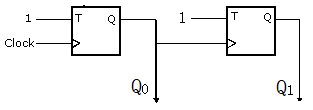
- A: 11, 10, 01, 00
- B: 10, 11, 01, 00
- C: 10, 00, 01, 11
- D: 11, 10, 00, 01
-
Choose the correct register transfer operations for the following diagram.
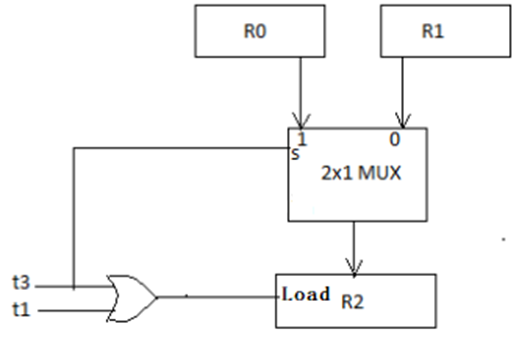
- A: $t_1: R2 \leftarrow R1;\ t_3: R2 \leftarrow R0$
- B: $t_1: R2 \leftarrow R1;\ t_1't_3: R2 \leftarrow R0$
- C: $t_1t_3': R2 \leftarrow R1;\ t_3: R2 \leftarrow R0$
-
You are designing a synchronous sequential circuit to detect the sequence "101" on a serial input stream. What is the minimum number of states required for a Mealy-type circuit and a Moore-type circuit, respectively?
- A: Mealy: 3 states; Moore: 3 states
- B: Mealy: 4 states; Moore: 4 states
- C: Mealy: 3 states; Moore: 4 states
- D: Mealy: 4 states; Moore: 5 states
Answer
-
A
- The load signal is asserted when \(A_3A_2=11\), so the counter loads \(0000\) after reaching \(1100_2=12\).
-
A (\(0001\ 0110\))
- Shift left: \(1011\ 0110 \to 0110\ 1100\).
- XOR with \(R2\): \(0110\ 1100 \oplus 0111\ 1010 = 0001\ 0110\).
-
A (11, 10, 01, 00)
- Both T flip-flops have \(T=1\), so they toggle. Starting from \(Q_1Q_0=00\), the ripple sequence is \(11 \to 10 \to 01 \to 00\).
-
C
- \(t_1\) enables load and selects input 0 of the MUX, so \(R2 \leftarrow R1\) when \(t_1t_3'\).
- \(t_3\) enables load and selects input 1 of the MUX, so \(R2 \leftarrow R0\).
-
C
- A Mealy detector can assert output on the transition that completes "101", requiring 3 states.
- A Moore detector needs an extra output state after the sequence is detected, requiring 4 states.