Ch 1 & 2. MLP Foundations
Architecture
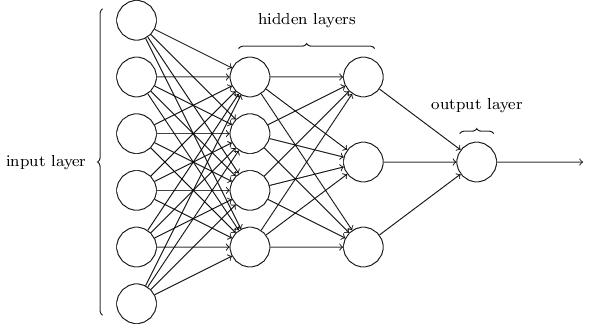
A Multi-Layer Perceptron (MLP) consists of layers of sigmoid neurons.
Notation
- \(\sigma(z) = \frac{1}{1+e^{-z}}\), with \(\sigma'(z) = \sigma(z)(1-\sigma(z))\).
- \(\odot\): Hadamard product (element-wise multiplication,
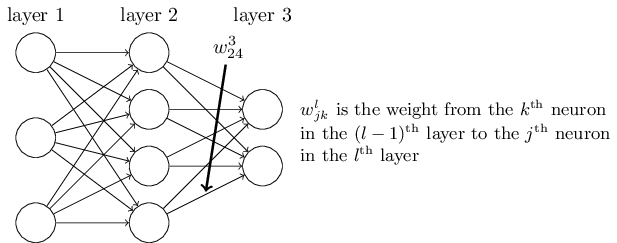
*in NumPy). - \(w^l_{jk}\): Weight from the \(k^{th}\) neuron in layer \((l-1)\) to the \(j^{th}\) neuron in layer \(l\).
- \(\delta^l_j\): The error of the \(j^{th}\) neuron in layer \(l\), i.e. \(\frac{\partial C}{\partial z^l_j}\).
Feed Forward
| Component Form | Matrix Form |
|---|---|
| \(a^l_j = \sigma(\underbrace{\sum_k w^l_{jk} a^{l-1}_k + b^l_j}_{z^l_j})\) | \(\vec{a}^l = \sigma(\underbrace{W^l \vec{a}^{l-1} + \vec{b}^l}_{\vec{z}^l})\) |
Backpropagation
These equations calculate the gradient of the cost function \(C\) with respect to weights and biases.
| ID | Component Form | Matrix Form | Description |
|---|---|---|---|
| BP1 | \(\delta^L_j = \frac{\partial C}{\partial a^L_j} \sigma'(z^L_j)\) | \(\vec{\delta}^L = \nabla_{\vec{a}} C \odot \sigma'(\vec{z}^L)\) | Error in the output layer \(L\): How much the cost changes w.r.t. the output activations. |
| BP2 | \(\delta^l_j = \sum_k w^{l+1}_{kj} \delta^{l+1}_k \sigma'(z^l_j)\) | \(\vec{\delta}^l = ((W^{l+1})^T \vec{\delta}^{l+1}) \odot \sigma'(\vec{z}^l)\) | Error BP: Propagates the error \(\vec{\delta}\) backward from layer \(l+1\) to layer \(l\). |
| BP3 | \(\frac{\partial C}{\partial b^l_j} = \delta^l_j\) | \(\frac{\partial C}{\partial \vec{b}^l} = \vec{\delta}^l\) | Bias gradient: The rate of change of the cost w.r.t. any bias is exactly the error \(\vec{\delta}\). |
| BP4 | \(\frac{\partial C}{\partial w^l_{jk}} = a^{l-1}_k \delta^l_j\) | \(\frac{\partial C}{\partial W^l} = \vec{\delta}^l (\vec{a}^{l-1})^T\) | Weight gradient: The product of the activation "input" and the error "output". |
Training
To minimize \(C\), we adopt SGD. Update parameters using mini-batches of size \(m\):
- Input: A batch of training examples.
- Feedforward: Compute \(\vec{z}^l\) and \(\vec{a}^l\) for each layer.
- Backpropagate: Compute errors \(\vec{\delta}^l\) using the 4 equations above.
- Update:
- \(W^l \rightarrow W^l - \frac{\eta}{m} \sum \nabla_{W} C\)
- \(\vec{b}^l \rightarrow \vec{b}^l - \frac{\eta}{m} \sum \nabla_{\vec{b}} C\)
- where \(\eta\) is the learning rate
Implementation
瞎写的。
Example
import random
import json
import numpy as np


class MLP(object):

    def __init__(self, sizes):
        self.num_layers = len(sizes)
        self.sizes = sizes
        self.biases = [np.random.randn(x, 1) for x in sizes[1:]]
        self.weights = [np.random.randn(y, x) for y, x in zip(sizes[1:], sizes[:-1])]

    def feedforward(self, a):
        for w, b in zip(self.weights, self.biases):
            a = sigmoid(w @ a + b)
        return a

    def SGD(self, training_data, epochs, mini_batch_size, eta, test_data=None):
        for epoch in range(epochs):
            random.shuffle(training_data)
            mini_batches = [
                training_data[i : i + mini_batch_size]
                for i in range(0, len(training_data), mini_batch_size)
            ]
            for mini_batch in mini_batches:
                self.update_mini_batch(mini_batch, eta)

            loss = self.total_loss(training_data)
            out_str = f"Epoch {epoch}, loss: {loss:.4f}"
            if test_data:
                acc = self.evaluate(test_data)
                out_str += f", acc {acc}/10000"
            print(out_str)

    def update_mini_batch(self, mini_batch, eta):
        nabla_b = [np.zeros(b.shape) for b in self.biases]
        nabla_w = [np.zeros(w.shape) for w in self.weights]
        for x, y in mini_batch:
            delta_nabla_b, delta_nabla_w = self.backprop(x, y)
            nabla_b = [b + db for b, db in zip(nabla_b, delta_nabla_b)]
            nabla_w = [w + dw for w, dw in zip(nabla_w, delta_nabla_w)]
        self.biases = [
            b - eta / len(mini_batch) * db for b, db in zip(self.biases, nabla_b)
        ]
        self.weights = [
            w - eta / len(mini_batch) * dw for w, dw in zip(self.weights, nabla_w)
        ]

    def backprop(self, x, y):
        a = [np.zeros((x, 1)) for x in self.sizes]
        z = [np.zeros((x, 1)) for x in self.sizes[1:]]
        delta = [np.zeros((x, 1)) for x in self.sizes[1:]]

        # Forward and store z
        a[0] = x
        for i, (w, b) in enumerate(zip(self.weights, self.biases)):
            z[i] = w @ a[i] + b
            a[i + 1] = sigmoid(z[i])

        # delta for output layer
        delta[-1] = self.cost_derivative(a[-1], y) * sigmoid_prime(z[-1])

        # delta for hidden layer
        for i in range(len(delta) - 2, -1, -1):
            delta[i] = (
                self.weights[i + 1].transpose() @ delta[i + 1] * sigmoid_prime(z[i])
            )

        nabla_b = delta
        nabla_w = [dd @ aa.transpose() for aa, dd in zip(a, delta)]

        return nabla_b, nabla_w

    def evaluate(self, test_data):
        test_results = [(np.argmax(self.feedforward(x)), y) for (x, y) in test_data]
        return sum(int(x == y) for (x, y) in test_results)

    def cost_derivative(self, output_activations, y):
        return output_activations - y

    def total_loss(self, data):
        loss = 0.0
        for x, y in data:
            a = self.feedforward(x)
            loss += 0.5 * np.linalg.norm(a - y) ** 2
        return loss / len(data)

def sigmoid(z):
    return 1.0 / (1.0 + np.exp(-z))


def sigmoid_prime(z):
    return sigmoid(z) * (1 - sigmoid(z))