Ch 4 & 5. Theoretical Universality & Practical Instability
Universality Theorem
A neural network with even a single hidden layer can approximate any continuous function to any desired accuracy.
It proves that a solution exists for almost any problem (translation, vision, etc.), though it doesn't guarantee that gradient descent will easily find it.
The Unstable Gradient
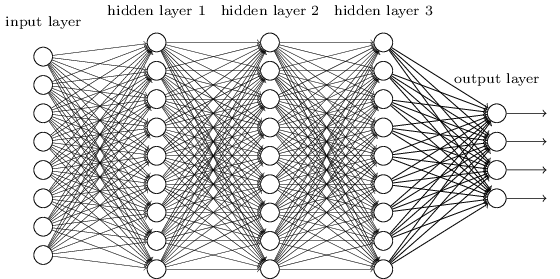
The gradient in early layers is calculated via the Chain Rule, resulting in a product of terms from all subsequent layers:
\[\delta^l = \Sigma'(z^l)(w^{l+1})^T \Sigma'(z^{l+1})(w^{l+2})^T \dots \Sigma'(z^L) \nabla_a C.\]
As a result, if we use standard gradient-based learning techniques, different layers in the network will tend to learn at wildly different speeds.
Vanishing Gradient
\[\delta^l = \underbrace{\Sigma'(z^l)(w^{l+1})^T}_{<1} \cdot \underbrace{\Sigma'(z^{l+1})(w^{l+2})^T}_{<1} \dots \Sigma'(z^L) \nabla_a C.\]
Exploding Gradient
\[\delta^l = \underbrace{\Sigma'(z^l)(w^{l+1})^T}_{>1} \cdot \underbrace{\Sigma'(z^{l+1})(w^{l+2})^T}_{>1} \dots \Sigma'(z^L) \nabla_a C.\]